

Connected devices are changing how businesses monitor operations, manage equipment, collect data, and deliver services. From smart home systems and industrial sensors to asset tracking and energy monitoring, the Internet of Things (IoT) enables physical devices to exchange information and respond to real-world conditions. Working with an experienced IoT Development Company can help businesses transform these connected devices into practical applications that improve visibility, automate tasks, and support better decisions.
An effective IoT solution combines hardware connectivity, embedded software, cloud infrastructure, application development, and security. Orbit Infotech approaches connected application development with a focus on business requirements, reliable data flow, usability, and long-term scalability.
What Does an IoT Development Company Do?
An IoT development company designs and builds software systems that connect physical devices to applications, networks, and cloud platforms. These systems allow businesses to collect device data, monitor performance, automate selected processes, and manage connected assets remotely.
Depending on the project, development may include:
- Firmware and embedded software integration.
- Device connectivity and communication protocols.
- Cloud-based IoT infrastructure.
- Web dashboards and mobile applications.
- Real-time monitoring and notifications.
- Data processing, analytics, and reporting.
- Integration with existing business software.
- Device management, security, and ongoing maintenance.
For example, a manufacturing company may use connected sensors to monitor machine temperature and vibration. A logistics business may track assets and receive alerts when equipment moves outside a defined area. A smart building may use connected controls to monitor lighting, occupancy, or energy consumption.
The right solution begins with a clear problem to solve rather than adding connectivity without a defined business purpose.
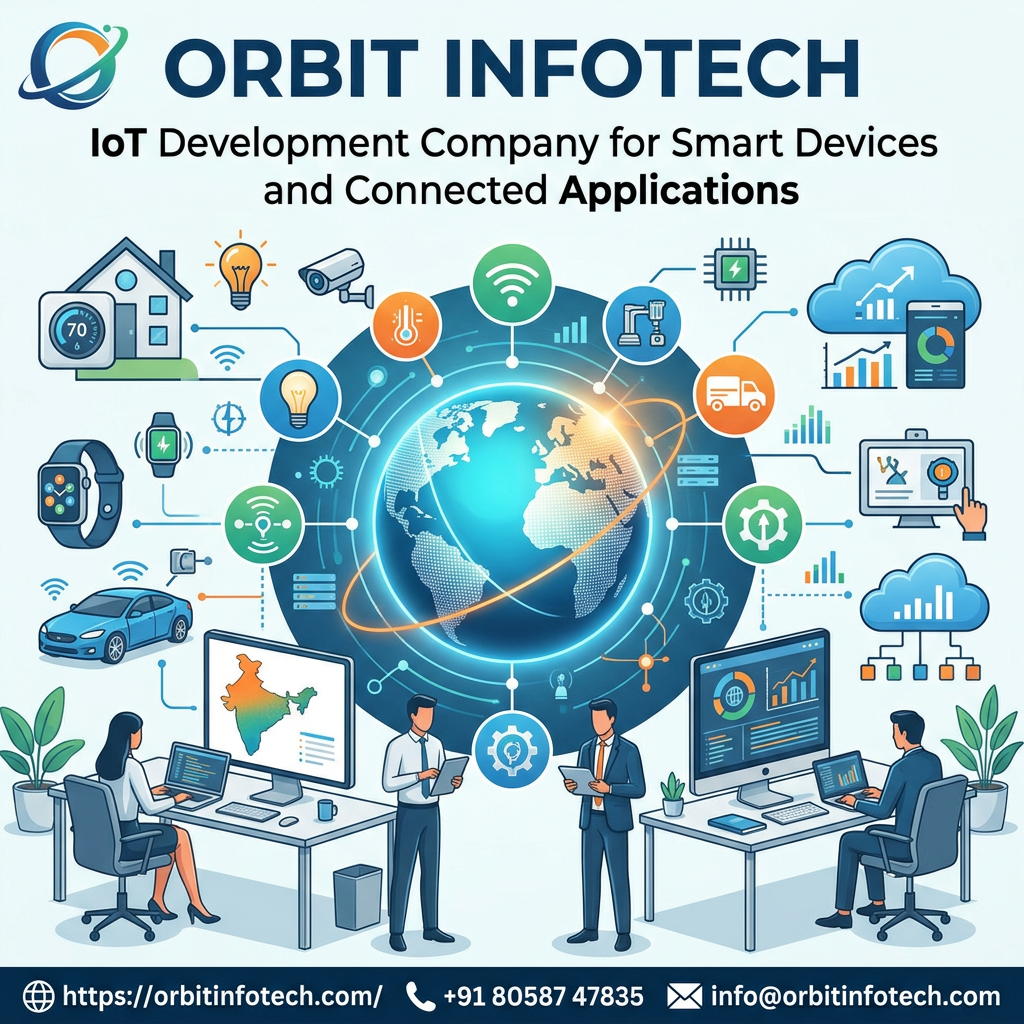
IoT Application Development Services for Connected Businesses
Professional IoT Application Development Services connect device data with interfaces and workflows that people can actually use. The application should present relevant information clearly and help users take appropriate action.
1. Smart Device Applications
Smart device applications let users monitor and control compatible equipment through a mobile or web interface. Examples include connected lighting, smart appliances, environmental sensors, and access-control systems.
Features may include device pairing, status monitoring, remote controls, notifications, usage history, and user permissions. The exact capabilities depend on the hardware, communication method, and system architecture.
2. Industrial IoT Applications
Industrial IoT applications help organizations collect operational data from machinery, production lines, and industrial environments.
Possible features include equipment status dashboards, sensor monitoring, maintenance alerts, production data analysis, and operational reporting. These systems can help teams identify unusual conditions and investigate potential problems before they disrupt operations.
For industrial environments, design should also account for network reliability, equipment compatibility, safety requirements, and the consequences of delayed or inaccurate data.
3. Asset Tracking and Fleet Monitoring
Connected tracking systems can provide information about the location, status, and usage of vehicles, equipment, or other valuable assets.
Depending on the hardware, these applications may combine GPS, cellular connectivity, Bluetooth, RFID, or other technologies. A dashboard can present location history, movement alerts, utilization information, and maintenance schedules.
The best technology depends on the required tracking accuracy, environment, battery life, connectivity coverage, and operating cost.
4. Smart Energy and Environmental Monitoring
IoT applications can monitor energy consumption, temperature, humidity, air quality, water usage, and other environmental conditions.
Businesses may use these insights to identify unusual consumption, understand usage patterns, and improve operational planning. Automated actions should be designed with suitable thresholds, safeguards, and manual override options where needed.
How an IoT Application Works
A typical IoT system connects physical devices to a backend platform and one or more applications.
<box gap={1} border radius="lg" padding={3}> <box background="surface-secondary" radius="md" padding={3} align="center" gap={1}> **1. Connected devices**
<text textAlign="center" size="sm">Sensors, machines, controllers, and smart hardware collect information.</text>
</box> <box align="center"> <icon name="arrow-down" size="lg" color="secondary" /> </box> <box background="surface" border radius="md" padding={3} align="center" gap={1}> **2. Connectivity and messaging**
<text textAlign="center" size="sm">Wi-Fi, cellular, Bluetooth, gateways, or protocols such as MQTT transfer data.</text>
</box> <box align="center"> <icon name="arrow-down" size="lg" color="secondary" /> </box> <box background="surface" border radius="md" padding={3} align="center" gap={1}> **3. Backend and data processing**
<text textAlign="center" size="sm">Cloud services authenticate devices, process events, store data, and apply business rules.</text>
</box> <box align="center"> <icon name="arrow-down" size="lg" color="secondary" /> </box> <box background="surface-secondary" radius="md" padding={3} align="center" gap={1}> **4. Applications and actions**
<text textAlign="center" size="sm">Web dashboards and mobile apps display insights, send alerts, and enable authorized controls.</text>
</box> </box>
Not every IoT project requires the same architecture. Some devices process information locally at the network edge, while others rely on cloud services. The design should reflect latency requirements, connectivity conditions, data volume, security needs, and the cost of operating the system.
Essential Features of a Reliable IoT Solution
A connected application should do more than display sensor readings. It must manage devices, present trustworthy information, and remain useful as the deployment expands.
Device management: Register devices, track status, manage configurations, and identify devices that stop communicating.
Real-time monitoring: Display incoming measurements and operational states with clear timestamps and units.
Alerts and notifications: Notify authorized users when readings cross defined thresholds or devices experience problems.
Data analytics: Turn historical readings into useful trends, summaries, and operational reports.
System integrations: Connect IoT data with inventory tools, maintenance platforms, CRM systems, ERP software, or other business applications where appropriate.
Scalability: Support the expected number of devices, messages, users, and data retention requirements.
Resilience: Handle temporary network failures, reconnect devices safely, and identify missing or delayed data.
These capabilities should be selected according to actual business requirements. Adding unnecessary features can increase development costs and make the system harder to maintain.
IoT Security: What Businesses Should Prioritize
Security must be considered from the beginning because IoT systems connect physical devices, networks, applications, and potentially sensitive operational data.
A well-designed solution should consider the following protections:
- Device identity: Give devices unique identities and suitable authentication credentials.
- Encrypted communication: Use secure communication channels, such as TLS where supported and appropriate.
- Access control: Restrict devices and users to the actions and data they require.
- Secure updates: Plan for firmware and software updates throughout the product lifecycle.
- Data protection: Collect only necessary information and apply appropriate storage, retention, and access policies.
- Monitoring: Record relevant events and investigate unusual connection or access activity.
- Lifecycle management: Plan how devices will be supported, decommissioned, or have credentials revoked.
AWS IoT security guidance highlights device authentication, encrypted communications, and appropriately scoped permissions as important controls. Security requirements should also account for the device's capabilities and deployment environment.
Businesses should assess security throughout development and operation rather than treating it as a final testing step.
Choosing the Best IoT Application Development Company in Jaipur
Businesses searching for the Best IoT Application Development Company in Jaipur should evaluate technical capabilities, project planning, integration experience, and long-term support.
An IoT project often requires coordination between hardware suppliers, embedded developers, cloud engineers, application developers, and security specialists. A development partner should understand how these components work together.
Before selecting a company, ask:
- Has the team worked with the required device types and connectivity protocols?
- Can it build both the backend platform and user-facing applications?
- How will device identity, data security, and access control be handled?
- What happens when devices lose connectivity?
- How will the solution be tested before deployment?
- Who will maintain the software and support updates after launch?
Review the proposed architecture, project milestones, documentation, and maintenance arrangements. A small proof of concept can be useful when device behavior, network conditions, or integration requirements remain uncertain.
Orbit Infotech encourages businesses to evaluate IoT development partners based on their ability to understand business needs, explain technical trade-offs, and build a solution that can be supported over time.
IoT Development Cost and Project Timeline
The cost of IoT development depends on the complexity of the devices, communication methods, backend infrastructure, application features, and security requirements. There is no single price that applies to every project.
A basic monitoring application using existing compatible hardware may be less complex than a custom system requiring firmware development, specialized sensors, real-time analytics, and integrations with enterprise software.
Project planning should account for:
- Hardware availability and device compatibility.
- Firmware and connectivity development.
- Cloud hosting and data storage.
- Web and mobile application requirements.
- Security testing and deployment.
- Ongoing monitoring, updates, and support.
A practical development process usually begins with requirements discovery, followed by architecture planning, a prototype or proof of concept, implementation, testing, deployment, and ongoing improvement. Defining measurable success criteria early helps teams control scope and assess whether the solution delivers the expected value.
Frequently Asked Questions
What is an IoT Development Company?
An IoT development company builds software systems that connect physical devices with networks, cloud platforms, and applications. Services may include device integration, embedded software, dashboards, mobile apps, analytics, and security.
What are IoT Application Development Services?
These services involve designing and building applications that collect, process, display, and act on data from connected devices. They can support monitoring, remote control, asset tracking, industrial operations, and smart environments.
Which industries benefit from IoT applications?
Manufacturing, logistics, agriculture, healthcare operations, energy management, retail, and smart building management can benefit from IoT when connected data solves a specific operational problem. The value depends on the use case and implementation.
How long does it take to develop an IoT application?
A proof of concept may take considerably less time than a production-ready platform. Timelines depend on hardware access, connectivity, integrations, security requirements, testing, and the number of features.
How can I choose an IoT application development company in Jaipur?
Assess the team's technical experience, device integration capabilities, security approach, testing process, documentation, and ongoing support. Ask for a clear project scope and consider starting with a proof of concept when requirements are uncertain.
Build Smarter Connected Applications With Orbit Infotech
IoT can help businesses turn device data into useful insights, improve operational visibility, and automate selected workflows. Achieving these benefits requires careful planning across hardware connectivity, application design, cloud infrastructure, security, and long-term maintenance.
Orbit Infotech supports a practical approach to software development that begins with business goals and prioritizes reliable, maintainable solutions. Whether you are planning a smart device application, an industrial monitoring platform, or a connected business dashboard, a clearly defined IoT strategy can provide a strong foundation for future growth.
Also Read: Technical SEO Guide for Ecommerce Websites and Online Stores